

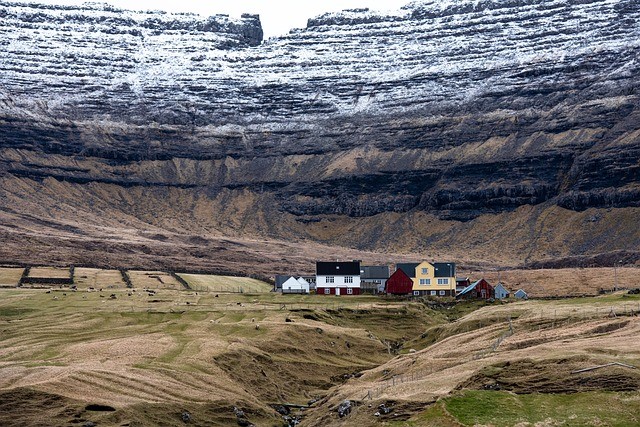
When you are in the Faroe Islands vacation, you are far away from the tourist hustle and bustle. But you can experience spectacular natural scenery that will give you the feeling that you are part of the Lord of the Rings trilogy and without having to fly halfway around the world. The fascinating and sometimes even bizarre landscape is unique and shaped by the stiff breeze of the North Atlantic. And despite the sometimes extremely rough weather and living conditions, the people here are friendly, humorous and open – if you meet any, because there are more sheep than residents here. Therefore, they are also known as Sheep Islands.
We show you what you should not miss on vacation on the Faroe Islands. Find the best travel tips, geographical location and currency of the islands, the cost of a trip to the Faroe Islands and the best local accommodation and hotels.
General information and tips
, formally belonging to Denmark The Faroe Islands are an autonomous archipelago of 18 islands in the North Atlantic. Neighbors are Iceland, Norway and the British Isles. The capital is Tórshavn. Just over fifty thousand people live on 1,395.74 square kilometers. The landscape of the rocky islands formed by volcanism is characterized by peaks and cliffs.
What language is spoken in the Faroe Islands?
National languages are Faroese and Danish. Faroese itself is descended from Old West Norse and more closely resembles Icelandic and Norwegian.
What is the currency in the Faroe Islands?
On holiday on the Faroe Islands you pay with Faroese kroner. According to the current exchange rate, one Faroese krone corresponds to just under 0.13 euros.
The inhabitants of the Faroe Islands
The residents themselves call themselves Fähringer and feel more like descendants of the Vikings than Danes. Because legends say that the Vikings landed on the Faroe Islands on their way to Iceland.
The landscape of the Faroe Islands
In general, the islands are an incredible paradise for hikers and nature lovers. The main island in particular invites you to a road trip that will take your breath away. Meet medieval ruins, lush greenery and waterfalls as far as the eye can see.
Entry information for holidays in the Faroe Islands
The Faroe Islands are part of the Schengen area, so you can enter without a visa. When entering Denmark, however, there are random passport controls. You either need your identity card or a valid passport. If you plan to travel from the Faroe Islands to Greenland, you will need a passport because you are leaving the Schnengen area.
Our pirate tip: Tourists are not allowed to bring pets into the Faroe Islands. This eliminates the holiday with a dog.
How to get to the Faroe Islands
There are several ways to travel to the Faroe Islands. You can choose to fly or take the ferry from Denmark. Both options take some time as there are no direct flights to the Faroe Islands. Nevertheless, the journey is worthwhile, because the transport connections from the mainland are pretty good. We’ll show you which options you can choose to plunge into your holiday adventure.
Flights to the Faroe Islands
You can from anywhere in Germany with a stopover in Copenhagen fly to the Faroe Islands an average of €214. From Hamburg, for example, a return trip to Vágar Airport (FAE), which is near Sørvágur, costs. You can also get there and back from Frankfurt or Stuttgart for an average of €219. The flights to the Faroe Islands are a bit higher in price, but they are also a very special travel destination.
Arrival by ferry
From Denmark you can cross to the Faroe Islands with Smyril Line. The ferry is modern and extremely comfortable. The comfortable cabins offer you sofa beds, a TV, a toilet and a bathroom. A great buffet is provided on board for catering. In summer there are twice a week departures from Hirtshals to the capital Tórshavn, in winter once a week. The crossing takes almost 38 hours.
From Germany you can either venture on a road trip – from Berlin it is almost 780 km to Hirtshals – or you can fly to Aalborg in Denmark, which is about 67 km away from Hirtshals. From Berlin or Munich it is an average of €130 for return flights to Aalborg.
If you are traveling by car, you can take it with you on the ferry. The crossing for two people and a car is just under 360 €, without a car you come to around 80 € per person.
Getting around the Faroe Islands
If you use public transport here, then it is not a matter of bus, train or tram, no, here you fly by helicopter. This is the only way children can get to school, for example, and their parents can get to work.
Weather and climate in the Faroe Islands
The maritime climate on the Faroe Islands is extremely changeable and very humid. It is not uncommon for sun, rain and fog to alternate spontaneously. The weather conditions can also vary in different places on the same island. Thanks to the Gulf Stream, however, the temperature is relatively balanced and there are hardly any large fluctuations. Snow rarely falls in winter and when it does fall, it rarely stays on the ground for long. Summers are relatively cool. A holiday in the Faroe Islands is a treat for your lungs as the air is extremely clear due to the windy and stormy weather in the North Atlantic.
Best travel time for the Faroe Islands
To explore the Faroe Islands extensively, the months of April to September are the best travel time. Then the days are usually long and you can expect little rain.
- High season : May to June
- Low season : September
Climate table for the Faroe Islands
Holidays in the Faroe Islands – the sights
Let’s get to the important things in life, namely the most beautiful sights and the best travel tips for your vacation on the Faroe Islands. What should you definitely not miss when you are there? Which place will take your breath away?
Sørvágsvatn
Sørvágsvatn is the largest lake in the Faroe Islands and is a true natural spectacle. It is located on the island of Vágar and is almost 3.4 km² in size. because of its location Sørvágsvatn is also known as the “lake over the sea”. From a certain vantage point, the lake almost seems to float above the sea as it sits just past the end of the cliffs that rise majestically from the stormy sea. A truly unique sight that you should not miss when on holiday in the Faroe Islands.
As if that weren’t enough, you can discover a wonderful waterfall at the end of the lake. Namely the Bøsdalafossur. The hike to the waterfall takes about 45 minutes. Just follow the gravel path at the end of the lake and let yourself be surprised.
Mykines
Mykines is the westernmost of the 18 islands and impresses with its spectacular beauty. From the island’s village of the same name, a wonderful hike leads past houses whose roofs are covered with lush green moss, rolling and deep green hills and breathtaking, sheer cliffs to a brilliant white lighthouse, which is located on the river island of Mykines. With this gigantic view, you almost feel as if you are standing at the end of the world.
If you are planning your holiday in the Faroe Islands for (early) summer: Between May 1st and August 31st you pay €13.40 for the tour. The money raised is invested in caring for the flora and fauna. By the way, like in Iceland, you can also discover puffins here.
Mower peaks
At almost 880 meters, Slættaratindur is the highest mountain in the Faroe Islands. On a clear day, you can get incredible panoramic views of the surrounding 17 islands from the top of the mountain. Traditionally, on June 21st, the longest day of the year, locals climb Slættaratindur to celebrate both sunrise and sunset. There are two routes for climbing Slættaratindur, depending on your fitness you can either start from Gjógv and choose the four-hour tour, or you can choose the easier and only one-hour tour from Eidisskarō. No matter how you finally climb to the top, the view is simply stunning and one of the highlights of a Faroe holiday.
Vidoy
And another highlight of your holiday in the Faroe Islands: Viðoy is the northernmost island in the archipelago. Here you should definitely include the village of Viðareiði on your itinerary, because Viðareiði is the starting point to the Enniberg cliffs, which rise majestically out of the wild North Atlantic and the incredible 750 meters! This makes the cliffs on Viðoy among the highest cliffs in the world, only exceeded by one place.
Excursion to Suðuroy
For your holiday in the Faroe Islands, we also recommend a visit to Suðuroy, the southernmost island in the Faroe Islands. It is almost 163.7 km² in size and inhabited by around 4,600 Farigners. The interesting thing is that the number of inhabitants is decreasing over the years instead of increasing. This is most likely because the island is extremely remote, even by Faroese standards. However, the people you meet here should be particularly open, friendly and also a bit emotional. Suðuroy itself is incredibly idyllic and shines in a rich green. In the west of the island you can visit fascinating steep cliffs.
On the island you will also find the village of Hov, built in honor of the Viking leader Havgrímur. Hov used to be a place where offerings were made to the Norse gods and the atmosphere of this magical place can still be felt today. Porkei, another village, is also steeped in history. Here you will find a beautiful wooden church that dates back to 1847.
Argue
Of course, the only cliffs that can surpass Enniberg are also found in the Faroe Islands, Kunoy to be precise. Kunoy generally has an extremely mountainous landscape, here you will find six mountains that break the 800 meter mark. You can feel extremely small between the giants. This is also where you’ll find the Nakkur Cliffs, which rise an absolutely insane 819 meters out of the sea. It can get queasy in the stomach and you should definitely not lean too far out of the window. But for a nature holiday, this Faroe Island is definitely recommended!
